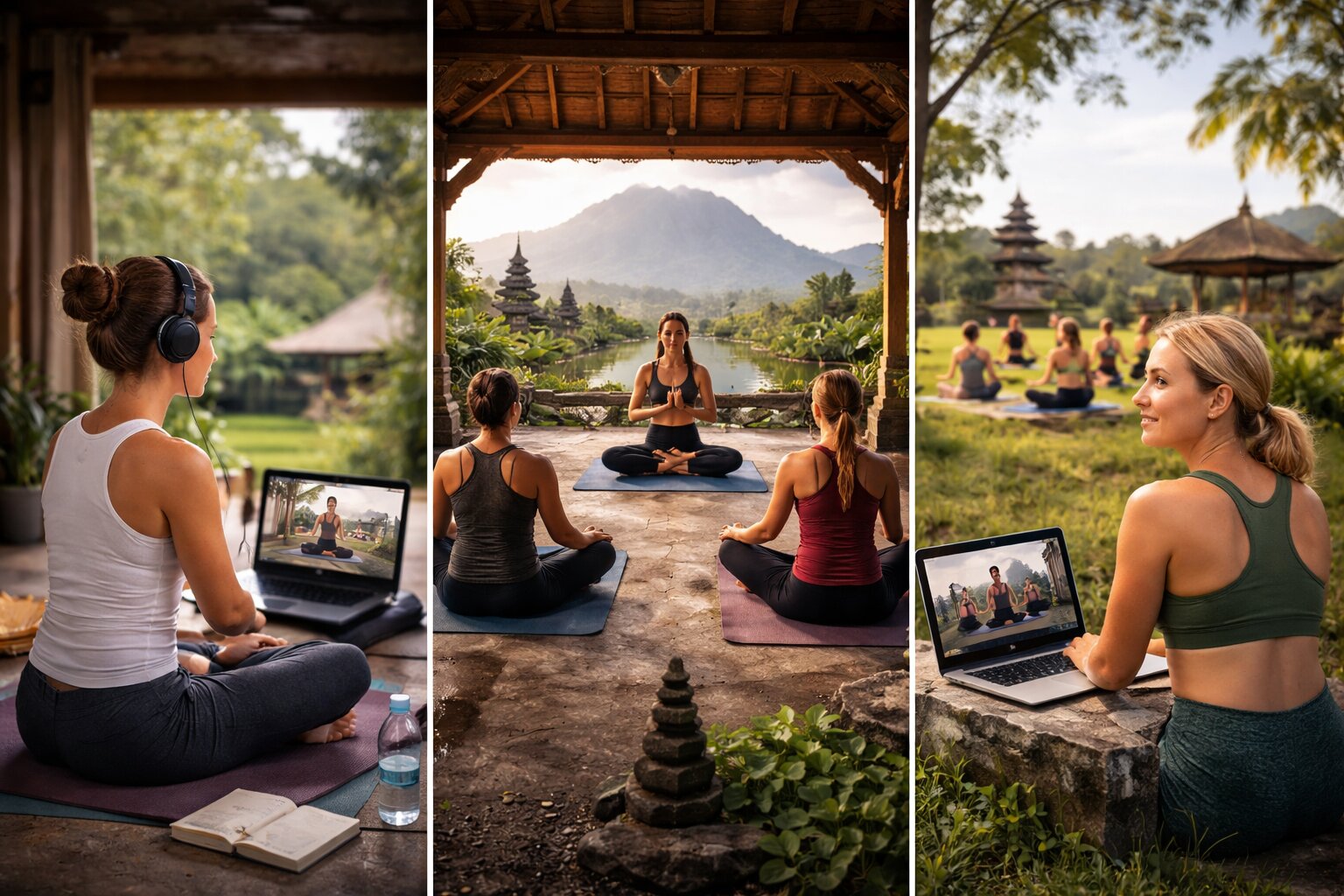
TL;DR: A 200-hour yoga teacher training in Bali comes in three formats: online, onsite, and hybrid. Online is the most flexible and affordable but limits hands-on practice. Onsite gives you full immersion in Bali for 3 to 4 weeks. Hybrid splits the program between self-paced online modules and an in-person Bali residency. The right format depends on your schedule, budget, and how you learn best.
You’ve found your 200-hour YTT in Bali. The dates look good. The school looks solid. Then you notice three options listed under the program: online, onsite, and hybrid. You’re not sure what the difference is, or whether it actually matters.
It does matter. Each format is a genuinely different experience. The curriculum may be the same, but how you learn, where you learn, and what you walk away with varies a lot.
This guide breaks down each format clearly so you can pick the one that fits your life right now.
What Does “200-Hour YTT” Actually Mean?
A 200-hour yoga teacher training is the entry-level certification recognized by Yoga Alliance, the largest international body for yoga education. It’s the minimum requirement to register as an RYT-200 (Registered Yoga Teacher) and teach professionally at most studios worldwide.
The 200 hours cover asana, pranayama, anatomy, yoga philosophy, teaching methodology, and practicum (practice teaching). All three formats cover the same core curriculum. What changes is the delivery method.
Yoga Alliance has recognized online and hybrid formats since 2020. As of 2024, online programs must include at least 15% of hours as synchronous (live) learning, meaning you attend real-time sessions, not just watch pre-recorded videos.
What Is an Online 200-Hour YTT?
An online 200-hour YTT is a fully remote program. You complete all training from home, typically through a mix of pre-recorded video lessons and scheduled live sessions over Zoom or a similar platform. You do not travel to Bali. The program is accredited by Yoga Alliance and qualifies you for the same RYT-200 credential as an in-person course.
Online programs run anywhere from 4 weeks to 6 months depending on the school. The self-paced structure gives you control over your schedule. You watch modules when it suits you and join live sessions at set times.
The biggest advantage is cost. Online programs cut out accommodation, flights, and meals. Many schools offer online 200-hour YTTs for under $1,000. In-person Bali programs typically range from $1,200 to $3,500, including accommodation.
The main limitation is hands-on learning. You can’t receive physical adjustments from a teacher. Practice teaching with peers happens over video. For some students, this is fine. For others, it’s a real gap.
- Fully remote, no travel required
- Most affordable format
- Self-paced with some live sessions
- No hands-on adjustments or in-person community
- Yoga Alliance recognized (check accreditation before enrolling)
- Best for: busy professionals, budget-conscious students, or those who can’t travel
What Is an Onsite 200-Hour YTT in Bali?
An onsite 200-hour YTT in Bali is a fully in-person, residential program. You travel to Bali and spend 2 to 4 weeks at the school. Classes run daily, typically 6 to 8 hours per day. Accommodation and meals are usually included. Everything happens on location, and you’re fully immersed from day one.
This is the traditional format. You live and train at or near the school. Most programs are set in Ubud, Canggu, or Uluwatu. The daily schedule is structured: morning practice, theory sessions, teaching methodology, afternoon workshops, and evening wind-down.
The intensity is the point. You learn faster when you’re surrounded by it all day. You get immediate feedback on your alignment, your cueing, and your energy as a teacher. You also build real relationships with your cohort, which many graduates say is one of the most valuable parts of the experience.
The trade-off is that you have to pause your regular life. Most onsite programs run 20 to 28 days. That’s a big ask if you have a job, family, or other commitments. And the total cost is higher once you factor in flights.
- Fully in-person, based in Bali
- 20 to 28 days, full-time immersion
- Hands-on adjustments, real-time feedback, strong community
- Higher total cost (training + flights + extras)
- Best for: those who can take time off and want the full Bali experience
What Is a Hybrid 200-Hour YTT in Bali?
A hybrid 200-hour YTT combines online learning with an in-person residency in Bali. The most common split is 100 hours online and 100 hours onsite. You complete the theory-heavy modules remotely at your own pace, then travel to Bali for the hands-on residency. Some programs flip this: you do the Bali portion first, then finish the remaining hours online from home.
The hybrid YTT in Bali is the fastest-growing format. It’s designed to give you the flexibility of online learning without giving up the in-person depth that makes Bali training special.
The online portion usually covers anatomy, philosophy, pranayama theory, and foundational sequencing. The Bali residency focuses on the hands-on work: asana practice, alignment workshops, adjustments, and live teaching practicum. This split makes practical sense. You don’t need to be physically present to study the Bhagavad Gita. But you do need a real teacher in the room when you’re learning to adjust a student’s trikonasana.
Bali residencies in hybrid programs typically run 10 to 16 days instead of the full 20 to 28 days. This shortens your time away and reduces costs compared to a fully onsite program. It also makes it possible for people who can’t take a full month off to still get real in-person training in Bali.
- Mix of self-paced online modules and a Bali residency
- Typical split: 100 hours online, 100 hours in Bali
- Bali residency is shorter (10 to 16 days) than fully onsite programs
- More affordable than onsite, more hands-on than fully online
- Best for: working adults who want real in-person experience but can’t take a full month off
Online vs Onsite vs Hybrid: Side-by-Side Comparison
| Factor | Online | Onsite (Bali) | Hybrid |
|---|---|---|---|
| Time in Bali | None | 20 to 28 days | 10 to 16 days |
| Scheduling flexibility | High | Low (fixed schedule) | Medium |
| Hands-on adjustment training | Limited | Extensive | Good (during residency) |
| Community & cohort bonds | Weak | Strong | Moderate |
| Total cost (excluding flights) | Lowest ($500 to $1,500) | Highest ($1,200 to $3,500) | Middle ($1,000 to $2,500) |
| Yoga Alliance recognized | Yes (if RYS-accredited) | Yes (if RYS-accredited) | Yes (if RYS-accredited) |
| Bali cultural immersion | None | Full | Partial |
| Best for | Budget, no travel | Full experience | Balance of both |
Which Format Is Right for You?
Choose online if you can’t travel or need maximum flexibility. Choose onsite if you want full immersion in Bali and can take 3 to 4 weeks away. Choose hybrid if you want real hands-on training in Bali but need to keep your time away shorter and your cost lower.
Here’s a simple way to think about it. Ask yourself three questions.
- Can I take 3 to 4 weeks off? If yes, onsite is worth considering. If not, hybrid or online fits better.
- Do I need hands-on adjustment and teaching practice? If yes, rule out fully online. Hybrid or onsite both deliver this.
- What’s my budget? Online is cheapest. Hybrid sits in the middle. Onsite is the highest investment when you include flights and extras.
One more thing to consider: your learning style. Some people absorb theory well through video and reading. Others need a teacher in the room to correct them. If you know you don’t learn well on your own, a fully online program may frustrate you. Be honest with yourself here before you pay a deposit.
You can compare yoga schools in Bali side by side on our directory to see which ones offer your preferred format and when they run.
One Thing to Always Check Before You Enroll
Regardless of format, always verify that the school is a Registered Yoga School (RYS) with Yoga Alliance before you pay. This is the only way to guarantee your certificate qualifies you to register as an RYT-200.
Not every program that calls itself “Yoga Alliance recognized” or “internationally certified” is actually accredited. Go to the Yoga Alliance website, search the school by name, and confirm their registration is active.
For online and hybrid programs, also check whether the live session requirement is met. As of 2024, Yoga Alliance requires at least 15% of online training hours to be synchronous (you and the teacher live together in real time). A 200-hour online program needs a minimum of 30 live hours. If the school doesn’t list this clearly, ask them directly before enrolling.
You can browse verified schools in our Bali YTT directory to find programs with clear accreditation details across all three formats.
Making Your Decision
All three formats lead to the same RYT-200 credential if the school is properly accredited. The credential itself is equal. What differs is the experience of getting there.
Online training is efficient and affordable. Onsite training in Bali is immersive and intensive. Hybrid training gives you real in-person depth without requiring you to drop everything for a month.
There’s no wrong answer. There’s just the format that fits your life right now.
If you’re still deciding, check our FAQ page for more common questions about Bali YTT programs. And when you’re ready to compare specific schools, our comparison tool breaks down programs by format, dates, location, price, and style so you can make a confident choice.
Frequently Asked Questions
Can I become a certified yoga teacher by doing an online YTT?
Yes. An online 200-hour YTT from a Yoga Alliance-accredited school qualifies you to register as an RYT-200. The certification carries the same weight as an in-person program. The key is making sure the school is a registered RYS with Yoga Alliance before you enroll.
Is a hybrid YTT recognized by Yoga Alliance?
Yes, as long as the school is a Yoga Alliance Registered Yoga School. The hybrid format is fully recognized. Make sure the online portion includes the required synchronous learning hours and that the in-person residency is led by qualified lead trainers.
How long does an onsite 200-hour YTT in Bali take?
Most onsite programs run between 20 and 28 days. Training happens daily, usually 6 to 8 hours per day. A small number of intensive programs compress the same curriculum into 14 to 18 days. Check the daily schedule before booking to understand the pace.
Is a hybrid YTT cheaper than a fully onsite program?
Usually yes. Because the Bali residency in a hybrid program is shorter (typically 10 to 16 days instead of 20 to 28), accommodation costs are lower. You still need to budget for flights. Overall, hybrid programs tend to sit between online and fully onsite in total cost.
Can I combine online hours from one school with in-person hours from a Bali school?
No. Yoga Alliance requires that all 200 training hours come from the same registered school. You cannot split hours across two different schools and combine them for RYT-200 registration. If you want a hybrid format, enroll in a single program that offers both components under one accreditation.