TL;DR: Yes. A 200-hour YTT in Bali is worth doing even if you never teach a single class. The program covers anatomy, breathwork, philosophy, and meditation, not just how to cue a warrior pose. Most of the value is in what you learn about yourself. If you want to understand your practice at a deeper level, or just do something genuinely challenging and focused, you don’t need a teaching plan to justify it.
The name causes the confusion. “Teacher training” sounds like it’s for people who’ve already decided: I’m going to teach yoga. But that’s not who fills most cohorts in Ubud or Canggu.
You’ll find people who burned out at work and needed three weeks that felt real. People who’ve practiced for years and hit a wall. People somewhere between one life and the next who wanted something structured to hold onto. A lot of them never teach. Most say it was worth it anyway.
So if you’re sitting with the question, here’s a straight answer.
What Actually Happens Inside a 200-Hour YTT?
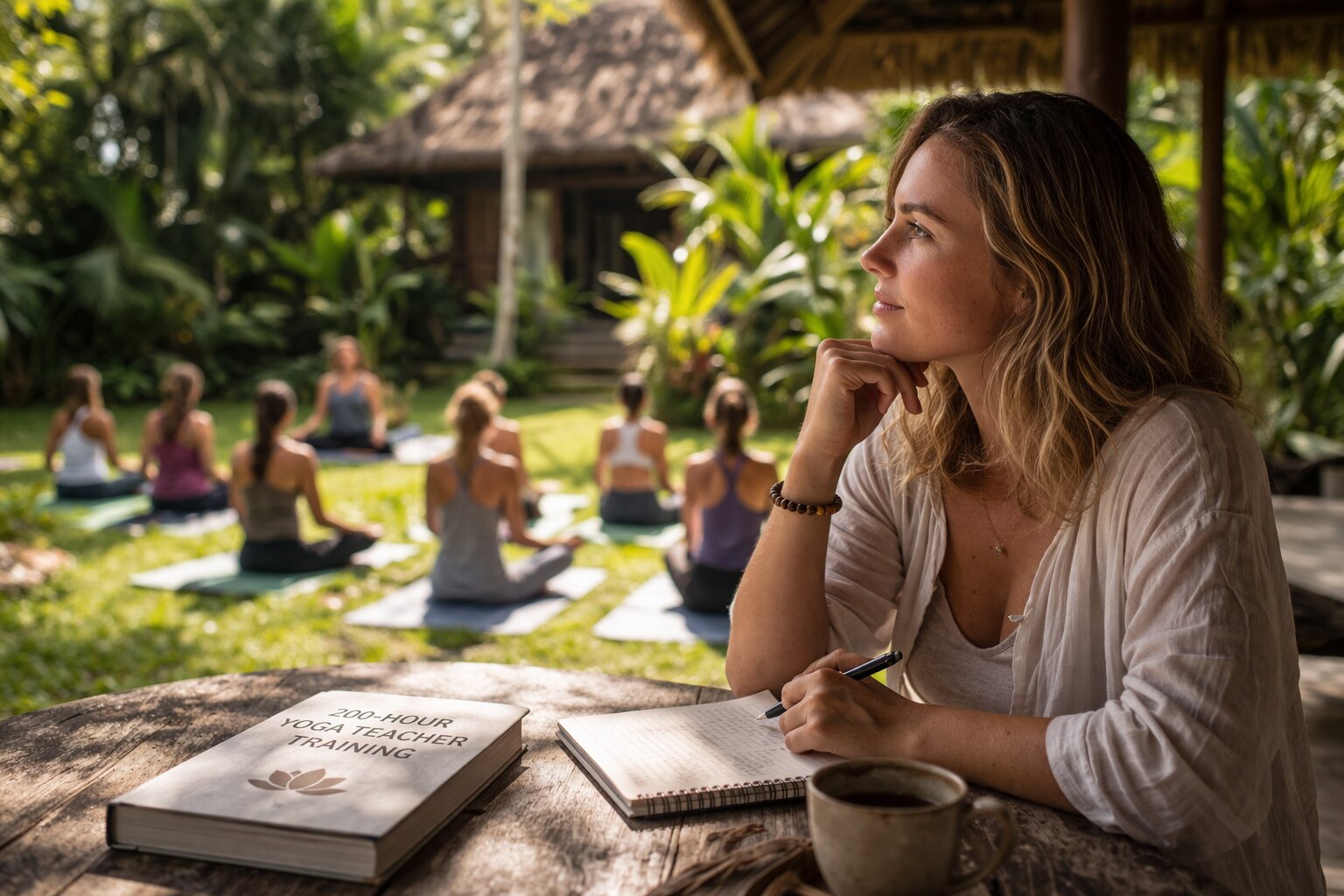
A 200-hour YTT covers anatomy, yoga philosophy, pranayama, meditation, sequencing, and the history of yoga alongside teaching methodology. The teaching component is real, but it’s maybe a third of what you actually study. The rest is understanding how yoga works as a system: for the body, the nervous system, the mind. That content applies to anyone, regardless of whether they ever lead a class.
The “teacher training” label implies the output is a license to teach. That’s misleading. It’s more accurate to call it a deep-study program that happens to include teaching practice.
You study the Eight Limbs of Yoga. Not as theory to memorize, but as a framework you sit with daily. Concepts like the Yamas (how you relate to others) and Niyamas (how you relate to yourself) sound abstract until you spend three weeks applying them. You study how the breath connects to the nervous system. You study anatomy and how bodies actually move under load. You read texts like the Yoga Sutras of Patanjali, which predate studio yoga by about 1,500 years and have nothing to do with sequencing a flow.
One school calls it as much a human being training course as a teacher training course. That’s not marketing. It’s an accurate description of what the curriculum actually covers.
What Do Non-Teaching Graduates Actually Get Out of It?
People who finish YTT without any plan to teach consistently report the same things: they understand their own body differently, they have actual tools for managing stress rather than just knowing they should manage stress, and something shifts in how they relate to themselves. None of that requires a class to teach.
The practice knowledge alone changes things. After 200 hours, you know why poses are sequenced the way they are. You understand what’s happening in the body during a forward fold or a twist. You stop doing poses because a teacher told you to and start doing them with some understanding of the mechanics. That stays with you every time you step on a mat.
The breathwork piece is underrated. Harvard Health research links yoga to increased levels of GABA in the brain, a neurotransmitter associated with reduced anxiety. You probably already knew yoga helps with stress. In YTT, you learn how that actually works, which makes the practices easier to use deliberately when you need them, not just in class but in real situations.
The philosophy sessions are the part people don’t expect to find useful. Concepts like satya (truthfulness) and svadhyaya (self-study) sound like they belong in a lecture. When you work with them every day for a month, they start showing up in how you talk to yourself and how you make decisions. That’s harder to quantify than a fitness outcome, but graduates talk about it more than almost anything else.
And then there’s the cohort. A shared intense experience builds something fast. The people you go through this with, you actually know them by the end. Not “workshop acquaintances.” People who’ve seen you uncomfortable and struggling and still there. That’s harder to find than it sounds.
Is the Cost Justified Without a Teaching Career?
A Bali YTT runs from around $1,200 to $3,500 including accommodation. Whether that’s worth it without a teaching goal depends entirely on how you value the experience itself. A comparable wellness retreat over the same weeks costs about the same and gives you far less to work with afterward. Most non-teachers who do YTT say the value surprised them. The certificate just sits there as a bonus.
This is the real sticking point for most people. The math feels off when you frame it as paying for a certificate you might never use.
Reframe it: you’re paying for 20 to 28 days of structured, focused development in a place that’s built for exactly that kind of experience. Daily practice. Philosophy. Anatomy. Breathwork. People who are taking it as seriously as you are. Teachers who have spent years on this material guiding you through it.
A month of backpacking Bali costs similar money and is genuinely great. But you come home with stories. YTT, you come home with a different relationship to your body and your mind. Both are real. Just different.
The certification also isn’t worthless as a future option. A lot of people who enroll with no teaching plan end up leading something eventually: a class at work, something informal for friends, a corporate wellness session years later. You don’t have to decide now. Having a Yoga Alliance RYT-200 means the option stays open without requiring you to repeat the training.
The Honest Downsides
YTT is not a retreat. Days run 6 to 8 hours. You’re practicing, studying, and being asked to sit with things that are sometimes uncomfortable. If you show up expecting relaxation, the schedule will genuinely catch you off guard.
Some sessions are built specifically around teaching skills: cueing, giving adjustments, leading sequences. If you have no interest in teaching, these sections are the ones that feel least relevant to you. They’re still useful for understanding how instruction works. But they’re also the clearest reminder that the program was built with teachers in mind.
The emotional side catches people by surprise too. Several weeks of self-inquiry in a group setting, in an unfamiliar place, away from your normal life tends to surface things. That’s not a problem. It’s kind of the whole mechanism. But it’s worth knowing it can happen before you book.
Who Is YTT Actually For?
YTT is for anyone who wants structured immersion in yoga as a complete system. The program is labeled “teacher training” because Yoga Alliance sets certification standards for instructors. But the content serves anyone who wants to understand yoga more fully. Non-teaching students make up a significant portion of most cohorts, and Bali schools are used to it.
Yoga Alliance built the certification framework for teachers. That’s where the name comes from. But the 200 hours of curriculum required to get that certification covers a lot more than how to lead a class. Schools aren’t going to turn you away because you’re not career-motivated. That’s not how it works in Bali.
If you’ve practiced for a few years and keep feeling like a 60-minute drop-in class doesn’t go far enough, that’s the right instinct. Studio classes are good for regular practice. They’re not built for understanding. YTT is where the understanding comes from.
What You’ll Actually Know After 200 Hours
Practical and specific, since the vague answer (“you’ll be transformed”) isn’t useful:
- Why your body does what it does in certain poses, beyond “the teacher said so”
- Breathwork techniques that shift your nervous system, and how to use them outside of class
- The difference between yoga philosophy as a historical subject and yoga philosophy as something that actually affects how you live
- How injuries happen in yoga and how to practice without creating them
- What a meditation practice looks like with real structure behind it
- What your own patterns are. The ones you bring to the mat and to everything else.
None of that requires a teaching career. It just requires showing up.
So, Is It Worth It?
If you’re asking “is the certificate worth $2,000 if I never teach?” then probably not. The certificate on its own isn’t the point.
If you’re asking whether 200 hours of structured study in Bali, focused entirely on understanding yoga at a level most people never reach, is worth the money and the time, the answer is yes for most people who go in clear-eyed about what it is. It’s not a vacation. It’s not a shortcut to anything. It’s a real commitment that pays off in real ways, teaching or no teaching.
When you’re ready to look at programs, browse verified Bali YTT schools and filter by dates, style, and location. The right fit matters more than you’d think.
Frequently Asked Questions
Can I enroll in a 200-hour YTT if I have no plans to teach?
Yes. Most Bali schools accept students regardless of teaching intention. Personal development and deepening practice are standard reasons to join. You don’t need to justify why you’re there. That said, it’s worth asking the school directly so you know what to expect from the teaching methodology sessions.
Will I be at a disadvantage in the class if I’m not aiming to teach?
No. The curriculum is the same for everyone. You’ll participate in practice teaching sessions like the rest of the cohort. Most non-teaching students find those sessions useful for understanding how instruction works, even if they never use that knowledge in front of a class.
What happens to my certificate if I decide to teach later?
It stays valid. You can register as an RYT-200 with Yoga Alliance at any point after completing your training from a registered school. There’s no expiry or deadline. Some graduates register the week they finish. Others wait years.
How intense is the daily schedule in a Bali YTT?
Expect 6 to 8 hours of structured activity per day: asana practice, philosophy, anatomy, pranayama, and teaching methodology. Most programs give you one full day off per week. It’s demanding. That’s also why it works. You don’t get the same depth from something easier.
Is it better to do YTT in Bali than online if my goal is personal growth?
For personal growth specifically, being physically there makes a real difference. The immersive environment, the cohort, the removal from normal life, all of it accelerates the kind of self-inquiry that makes YTT valuable. Online programs cover the same content. But the environment is doing a lot of the work in an onsite Bali program, and you can’t replicate that on Zoom.