
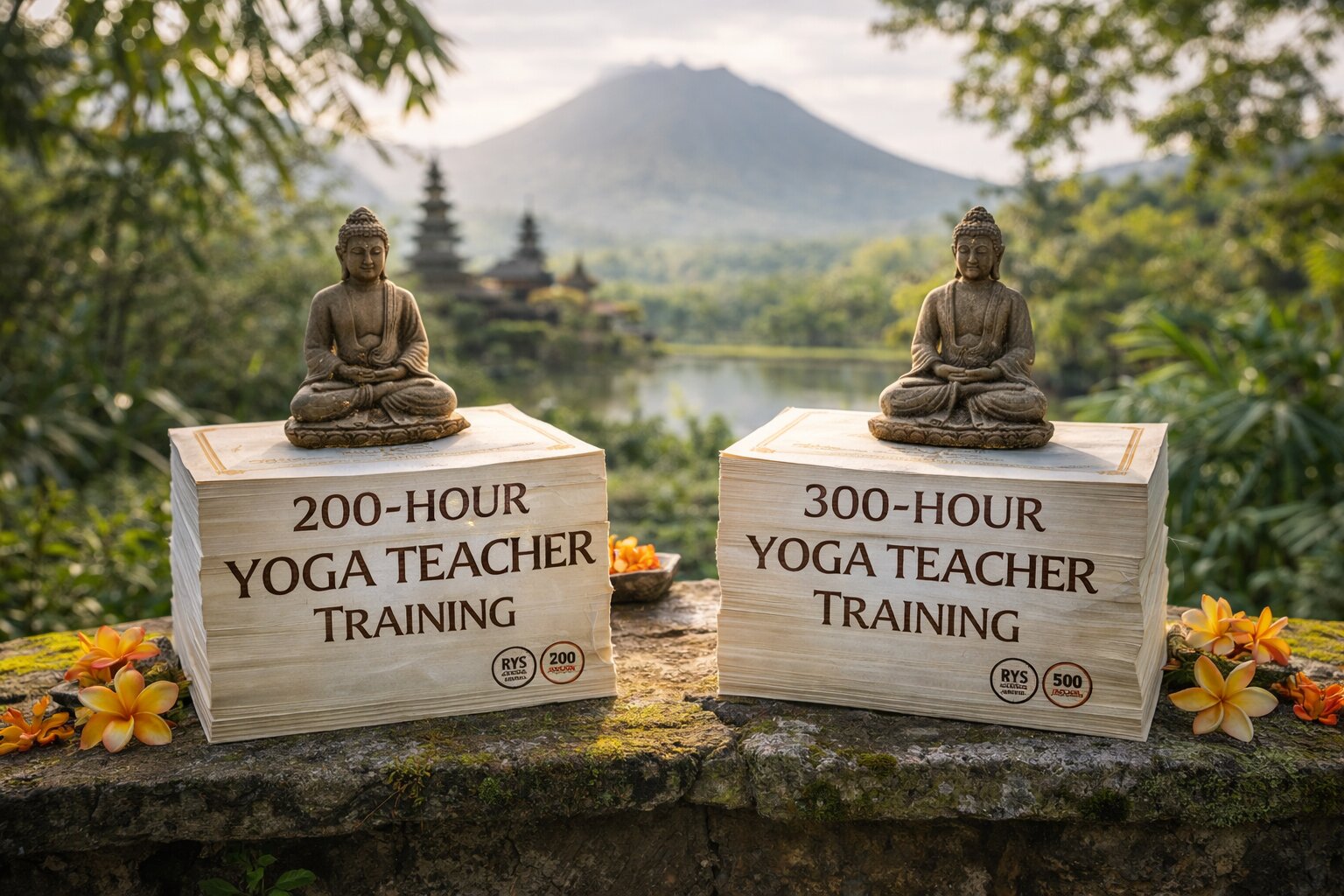
TL;DR: Almost everyone should start with the 200-hour YTT. It’s the required foundation. You can’t do a 300-hour without it, and most Bali schools won’t let you try. The 300-hour is an advanced program for people who already hold a 200-hour cert and want to push deeper, specialize, or earn the RYT-500 credential. If you’re at the beginning, the answer is straightforward: start with the 200.
The question comes up a lot, and it’s a fair one. You see both programs listed on school websites, both run in Bali, and the pricing isn’t wildly different. It’s reasonable to wonder if you can skip ahead or if one is genuinely better suited to where you are right now.
Here’s the actual answer: they’re not two options at the same level. They’re sequential steps. The 300-hour assumes you already finished the 200-hour. It covers advanced content, not alternative content.
But understanding why that’s the case, and what each program actually covers, is what makes the decision clear. So let’s go through it properly.
What Is a 200-Hour YTT?
A 200-hour YTT is the foundational yoga teacher training certification recognized by Yoga Alliance worldwide. It covers asana technique, yoga philosophy, anatomy, pranayama, teaching methodology, and supervised practice teaching. Completing it qualifies you to register as an RYT-200 (Registered Yoga Teacher) and is the minimum requirement to teach professionally at studios globally. It’s where everyone starts.
The curriculum spans all the core areas: how to sequence a class, how the body moves through yoga poses, the Eight Limbs of Yoga, anatomy and injury prevention, breathwork, meditation, and how to actually instruct a room of students. None of it is surface-level. It’s 200 hours of material, which in Bali typically unfolds over 20 to 28 days of full-time training.
The 200-hour is the degree. The 300-hour is the postgraduate.
You can start teaching the day after you graduate with a 200-hour cert from a registered school. Most yoga studios worldwide accept it as the standard credential. Yoga Alliance lists it as the entry point for all teachers, and that hasn’t changed.
What Is a 300-Hour YTT?
A 300-hour YTT is an advanced program for people who already hold a 200-hour certificate. It is not a standalone course. Completing it adds 300 hours to your existing 200-hour training, totaling 500 hours and qualifying you for the RYT-500 credential. The curriculum goes deeper into advanced asana, specialized populations, yoga therapy, anatomy, pranayama, philosophy, and teaching refinement. It assumes you already know the basics.
The 300-hour doesn’t re-teach what the 200-hour covered. It builds on it. Schools running 300-hour programs in Bali require proof of your 200-hour cert before you can enroll. If you show up without one, you’re not joining.
The content focus shifts significantly. Less time on “here’s how yoga works” and more time on advanced pranayama techniques, yoga nidra, Ayurveda, specialized teaching for injuries or specific populations, deeper philosophy texts like the Bhagavad Gita and Yoga Sutras, and refined teaching practice with real feedback. One school describes it accurately as graduate school for yogis. The comparison holds.
In Bali, most 300-hour programs run around 24 to 28 days, sometimes slightly longer than the 200-hour because there’s more to cover and the expectation is that students can handle a denser schedule.
The Certification Path: How They Connect
200-hour + 300-hour = RYT-500. That’s the math. Yoga Alliance’s highest standard certification, the RYT-500, requires 500 total training hours. The standard path is to complete a 200-hour program first, register as an RYT-200, gain some teaching experience, then complete a 300-hour program from a registered school. After that, plus a minimum of 100 documented teaching hours, you can register as an RYT-500.
There’s also a standalone 500-hour program at some schools, which compresses both levels into one long continuous training. That path exists, but it’s less common in Bali and demands a much larger block of time upfront.
The RYT-500 matters if you want to lead teacher trainings yourself eventually. To become an E-RYT 500 (Experienced Registered Yoga Teacher), which is what schools require of their lead trainers, you need the full 500 hours of training plus two years of teaching and 1,000 documented teaching hours after your initial cert. The 300-hour is the step that gets you there.
For most people just starting out, the RYT-500 is a future consideration, not a right-now one. You do the 200-hour. You teach. You get good. Then the 300-hour makes sense.
What Each Program Actually Covers: Side by Side
| Area | 200-Hour YTT | 300-Hour YTT |
|---|---|---|
| Asana | Foundation poses, alignment, modifications | Advanced poses, arm balances, inversions, specialized sequences |
| Anatomy | Foundational body systems, injury basics | Deep functional anatomy, teaching for injuries and specific populations |
| Philosophy | Introduction to Eight Limbs, Sutras overview | In-depth study of Bhagavad Gita, Sutras, Vedic texts, Ayurveda |
| Pranayama | Core techniques, breath mechanics | Advanced techniques, kriyas, bandhas, mudras |
| Meditation | Foundational practices and instruction | Yoga nidra, advanced contemplative practices, specialized methods |
| Teaching practice | 5+ hours lead teaching, peer feedback | 30+ hours practicum, advanced cueing, real student feedback |
| Credential earned | RYT-200 | RYT-500 (combined with your 200-hour) |
| Prerequisite | None | 200-hour certificate required |
| Duration in Bali | 20 to 28 days | 24 to 30 days |
| Typical cost in Bali | $1,200 to $3,500 | $1,800 to $4,000 |
Who the 200-Hour Is For
The 200-hour is for anyone who hasn’t yet completed a yoga teacher training. That includes people who want to teach, people who just want to go deep into the practice, career switchers, long-time practitioners who want a credential, and anyone for whom this is their first structured training. If you don’t have a certificate yet, this is your program.
In Ubud, Canggu, and across Bali generally, 200-hour cohorts are a mix. Some students are serious career changers. Some have been practicing for ten years and want to actually understand what they’ve been doing. Some are there for the personal development, with zero intention to teach.
The 200-hour doesn’t require prior teaching experience. It doesn’t require years of practice. Most schools ask for some familiarity with yoga, but there’s no minimum hours-per-week benchmark. The curriculum builds you from wherever you are.
What it does require is that you show up and take it seriously. It’s 6 to 8 hours a day. It’s physically and mentally demanding. But it’s designed for people doing this for the first time, which is the crucial distinction from the 300-hour.
Who the 300-Hour Is For
The 300-hour is for teachers who already hold a 200-hour cert, have been teaching, and feel they’ve hit a ceiling. Maybe students are asking questions you can’t fully answer. Maybe you want to specialize in a style or population. Maybe you’re aiming for the RYT-500 to lead trainings one day. That’s the profile. Not a beginner. Someone who’s been in classrooms and knows exactly what they still don’t know.
One Bali school frames it well: the 200-hour teaches you how to drive a car. The 300-hour teaches you what’s under the hood. That’s about right. The program doesn’t hold your hand through concepts you should already have from your first training. It assumes you can sequence a class and understand basic anatomy. Then it pushes past that.
The teaching practicum hours in a 300-hour are notably more intensive. You’re expected to lead longer sequences, handle more complex student needs, and receive detailed feedback on your actual teaching style. For someone who just finished a 200-hour, this pace would be overwhelming. For someone who’s been teaching for a year or two, it’s exactly the challenge they’ve been looking for.
If you’re asking “which should I do first?” and you haven’t done either, the 300-hour isn’t an option yet. Most Bali schools check for your certificate before you can book. That’s not bureaucracy; it’s the program being built for a level of experience you haven’t had yet.
Can You Do the 300-Hour Without the 200-Hour?
Technically, a small number of schools don’t enforce the prerequisite. Practically, you shouldn’t.
The 300-hour curriculum assumes you already know what the 200-hour covered. Philosophy sessions won’t stop to explain the Eight Limbs. Anatomy workshops won’t revisit basic body systems. Practicum sessions expect you to lead sequences, not just observe them.
Going in without the foundation means you’ll be lost for a significant portion of the training. You’ll pay for 300 hours and absorb maybe 100 of them properly. It’s a waste of money and time, and you’d still need to go back and do the 200-hour afterward to actually teach with a recognized credential.
The order exists for a reason. Do it in order.
The Honest Comparison on Cost and Time
In Bali, the price difference between a 200-hour and 300-hour isn’t as dramatic as you’d expect given the hour difference. Both programs include accommodation and meals in most cases. The 300-hour costs more because it runs longer and the teaching expertise required is higher, but you’re not doubling your spend to go from one to the other.
Time is the bigger variable. If you can take 28 days, the 200-hour works. If you’re already certified and can take another 28 days later, the 300-hour works. They each require roughly the same block of time. The question is really when in your trajectory each one fits.
A common path for serious students: complete the 200-hour in Bali, return home, teach for a year or two to build real classroom experience, then come back to Bali for the 300-hour. Bali’s school density and quality makes it a practical destination for both legs of that journey. Many schools in Ubud run both programs and will remember you from your first training.
The Short Answer, If You’re Still Deciding
Haven’t done any YTT yet? Do the 200-hour. Full stop. It’s not a compromise or a stepping stone you’ll regret. It’s the actual foundation, and the quality of your 300-hour later depends on how well you built it.
Already hold a 200-hour cert, have been teaching, and want to go deeper? The 300-hour is the move, and Bali is one of the best places to do it.
Trying to skip the 200-hour and go straight to the 300? You can’t at most schools, and you shouldn’t even where you technically could.
Ready to start exploring your options for the 200-hour in Bali? Browse programs on the 200-hour YTT Bali page and filter by location, style, and dates. The right school matters more than most people realize, and comparing them upfront saves you from picking the wrong one.
Frequently Asked Questions
Can I go directly to a 300-hour YTT in Bali without a 200-hour cert?
Most Bali schools require proof of a 200-hour certificate before enrolling you in a 300-hour program. A small number don’t enforce this strictly, but the curriculum assumes you already have that foundation. Going in without it means large sections of the training won’t make sense. It’s not worth doing out of order.
Does the 300-hour have to be done at the same school as my 200-hour?
No. Yoga Alliance allows you to combine a 200-hour and a 300-hour from different registered schools to earn the RYT-500 credential. The schools just both need to be Yoga Alliance Registered Yoga Schools. Many people do their 200-hour at one school and their 300-hour at another, sometimes years apart.
How long should I wait between my 200-hour and 300-hour?
There’s no required waiting period. But most experienced teachers recommend getting at least 6 to 12 months of actual teaching under your belt first. The 300-hour is most useful when you already have real classroom experience. You’ll know what questions to bring to it, and you’ll absorb the advanced content more effectively.
What credential do I get after the 300-hour?
Completing a 300-hour program from a registered school, combined with your 200-hour cert and a minimum of 100 documented teaching hours, qualifies you to register as an RYT-500 with Yoga Alliance. That’s the highest standard certification Yoga Alliance offers and is required to eventually lead your own teacher trainings as a lead trainer.
Is the 300-hour YTT in Bali worth doing even if I don’t want to lead teacher trainings?
Yes, if you want to teach at a higher level. The advanced anatomy, specialized population training, and refined teaching practice in a 300-hour program make you a meaningfully better teacher for everyday classes, not just for running trainings. Many RYT-500 teachers never lead a teacher training. They just teach better classes.