
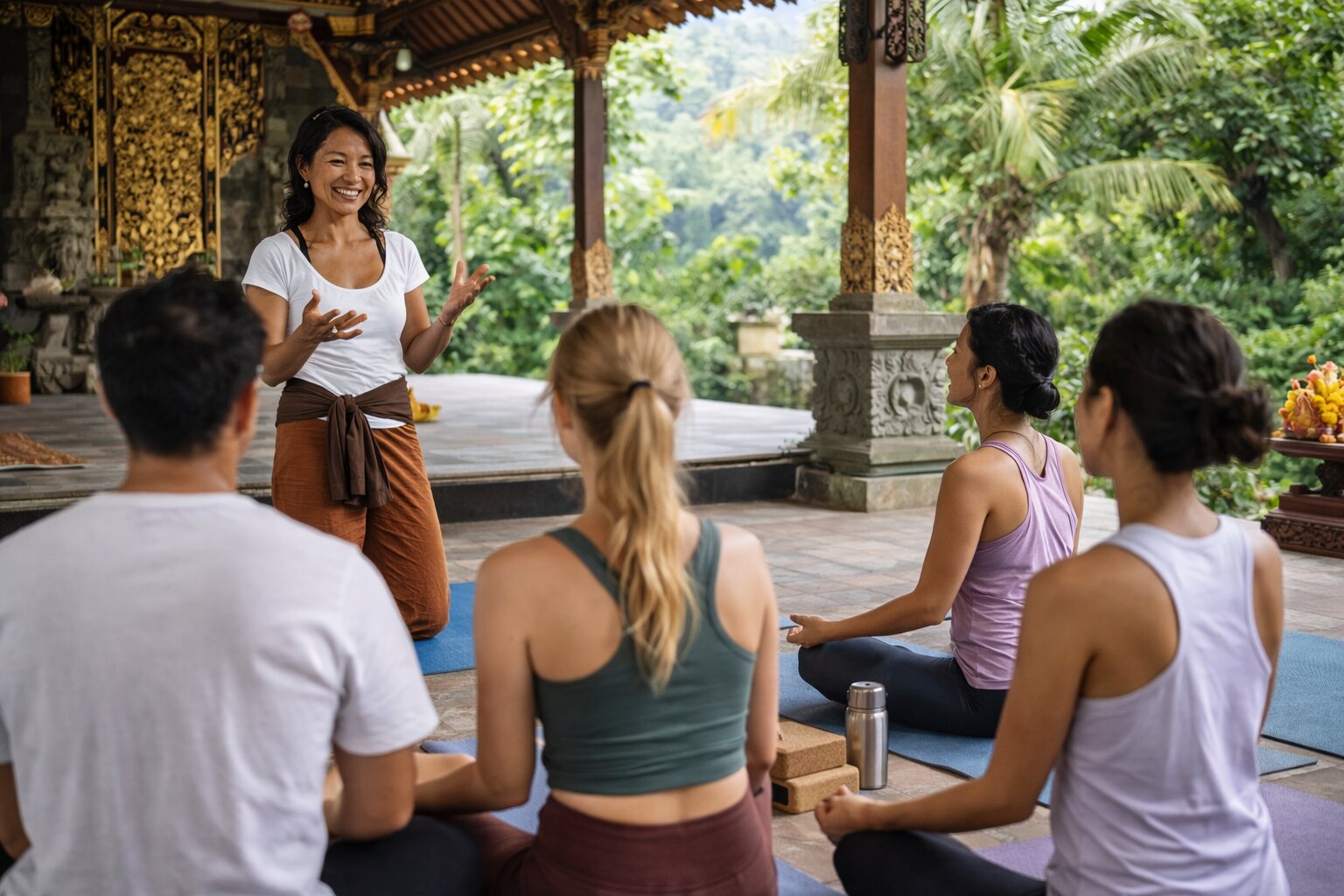
TL;DR: Yes, a complete beginner can do a 200-hour YTT in Bali. Most programs are built as foundational training, and Yoga Alliance does not require prior teaching experience or an advanced practice. You don’t need to touch your toes or nail every pose. What you do need is the commitment to show up for a demanding daily schedule. Picking a beginner-friendly school and doing some preparation beforehand makes a real difference.
If you’ve been putting off a 200-hour YTT in Bali because you think you’re not ready yet, there’s a good chance you’re wrong.
The most common thing holding beginners back isn’t a lack of skill. It’s a belief that everyone else will be more advanced, more flexible, or more “yoga” than them. The reality is different. Most training groups are a mix of backgrounds, levels, and reasons for being there. Some students come with years of practice. Others have barely stepped on a mat.
This guide gives you a clear, honest answer to the question beginners ask most: am I ready? It covers what Yoga Alliance actually requires, what daily training looks like physically, how to choose the right school, and how to prepare if you have a few months before you arrive.
Can a Complete Beginner Do a 200-Hour YTT?
Yes. A 200-hour yoga teacher training is designed as a foundational program. Yoga Alliance, which sets the global standard for teacher training programs, does not list prior yoga experience as a requirement for 200-hour certification. The training is built to take students from the ground up, covering postures, anatomy, philosophy, breathwork, and teaching methodology from scratch.
That said, there is a difference between being a beginner and being unprepared. The two are not the same thing.
Being a beginner means you haven’t practiced long or deeply. That’s fine. Most 200-hour programs expect this and build their curriculum accordingly. Being unprepared means arriving without any sense of what to expect, skipping basics that could have been covered ahead of time, or underestimating how physically demanding a daily training schedule will be.
The goal of this article is to help you arrive as a prepared beginner, not just a beginner.
You Don’t Need to Be Flexible. Here’s What You Actually Need.
Flexibility is not a requirement for a 200-hour YTT. Every reputable program teaches modifications for each pose, and teachers are trained to work with all body types and ranges of motion. What matters more is your ability to practice consistently for three to four weeks, your openness to learning, and your willingness to study in the evenings after a full day of physical training.
Here are the myths worth setting aside before you book:
- You need to do a handstand. You don’t. Advanced inversions are not a requirement or a benchmark in a foundational 200-hour program.
- You need to touch your toes. You don’t. Flexibility develops during the training. You’re there to learn how the body works, not to perform.
- You need years of regular practice. You don’t. Many students join a 200-hour YTT with less than six months of practice behind them.
- You need to be young or very fit. You don’t. Yoga teacher trainings regularly welcome students in their 40s, 50s, and 60s.
What the training does ask of you physically is consistency. A typical Bali YTT runs five to six days per week for three to four weeks. Each day usually includes two to three hours of physical practice, plus lectures, teaching methodology sessions, and self-study in the evenings. That is a full day, every day.
You don’t need to be strong or flexible to handle it. But you do need to be willing to commit to it fully.
What You’ll Learn as a Beginner in a 200-Hour YTT
One reason beginners often do well in a 200-hour YTT is that the program isn’t actually just about physical postures. According to Yoga Alliance standards, an accredited 200-hour program must cover four core areas:
| Subject Area | Hours | What It Covers |
|---|---|---|
| Techniques, Training and Practice | 75 hours | Asanas (postures), pranayama, meditation, chanting |
| Anatomy and Physiology | 30 hours | How the body moves, muscles, joints, safe alignment |
| Yoga Humanities | 30 hours | Yoga philosophy, history, ethics |
| Professional Essentials | 50 hours | Teaching methodology, practice teaching, feedback |
Physical postures make up only a portion of the total training. A significant chunk of your time will be in the classroom, studying anatomy, reading yoga texts, and learning how to sequence and teach a class.
This is actually a leveler for beginners. A student who has practiced yoga for five years still needs to learn how to teach it. When it comes to explaining why a pose works, how to cue a transition safely, or what the eight limbs of yoga mean, everyone in the room is starting in a similar place.
Poses are taught step by step, with modifications built in. You’ll learn how to teach each posture before you’re expected to master it yourself.
Why Bali Is Especially Good for Beginner YTT Students
Bali’s immersive environment removes daily distractions and builds your entire routine around practice and study. For beginners especially, that structure is an advantage. You’re not trying to squeeze yoga into your normal life. For three to four weeks, yoga is your life. That kind of focus accelerates learning in a way that’s hard to replicate anywhere else.
Most Bali YTT programs are residential. You stay on-site or very close to the school, meals are provided, and your schedule is set for you. This removes a lot of decision-making from your day and keeps you in the learning environment almost continuously.
Bali also brings something less tangible but genuinely felt by most graduates: a sense of presence. The island has a deeply rooted spiritual culture, and its rhythm, temples, rice fields, and ceremonies naturally encourage slowness and reflection. That backdrop supports the inner work that a 200-hour training asks of you, whether you’re an experienced practitioner or a complete beginner.
The community you build with fellow students matters too. Most Bali training groups include people from many different countries and backgrounds. Beginners are common, and the shared experience of being outside your comfort zone together creates a kind of bond that carries people through the harder days.
Bali has a wide range of locations suited to training. Ubud is the most popular for YTT students, with its quiet inland setting, established yoga culture, and concentration of reputable schools. Other areas offer their own environment and pace.
How to Choose the Right School If You’re a Beginner
Not all schools in Bali have the same entry requirements or teaching style. Some specifically market to beginners and emphasize a supportive, step-by-step approach. Others are aimed at intermediate or experienced practitioners and may expect you to already know foundational poses before you arrive.
Here’s what to look for when comparing schools as a beginner:
- Check their entry requirements explicitly. Some Bali schools ask for a minimum of one to two years of regular practice. If a school says this, respect it. Apply to one that genuinely welcomes beginners instead.
- Look at class sizes. Smaller groups mean more individual attention. As a beginner, personalized feedback from teachers makes a significant difference, especially when you’re learning to teach from scratch.
- Read recent student reviews carefully. Look for comments from students who joined as beginners. Did they feel supported? Were modifications offered consistently? Did the pace feel manageable?
- Ask before you book. Email the school directly and tell them your experience level. A good school will give you an honest answer about whether the program fits where you are.
- Check the yoga style. Hatha-based programs tend to be slower and more alignment-focused, which suits beginners well. High-intensity Ashtanga-led programs may be more demanding physically in the early weeks.
Use the Bali YTT school directory to browse verified programs and filter by level. The school comparison tool lets you put programs side by side so you can see key differences before reaching out.
How to Prepare Before You Arrive
If you have two to three months before your YTT, practice yoga three to four times per week. This doesn’t need to be advanced practice. Showing up consistently and getting your body used to daily movement is the goal. Add some basic reading on yoga philosophy and learn a handful of common Sanskrit pose names. This preparation isn’t required, but it will reduce overwhelm in your first week significantly.
Here’s a simple preparation checklist you can work through before you fly:
- Practice yoga 3–4 times per week for at least 6–8 weeks before arrival
- Learn the names of 15–20 common poses in both English and Sanskrit
- Read an introductory book on yoga philosophy (the Yoga Sutras of Patanjali is a good starting point)
- Build a basic meditation habit, even 5–10 minutes per day helps
- Get physically used to sitting on the floor for extended periods (for classroom sessions)
- Research the style of yoga your school teaches and take a few classes in that style before you arrive
- Sort your visa, travel insurance, and accommodation well ahead of time
You don’t need to arrive as an intermediate practitioner. You just need to arrive as someone whose body has been moving regularly and whose mind has had some exposure to yoga as a subject, not just a workout.
Schools that welcome beginners know how to meet you where you are. The preparation above simply helps you get more out of the first week, when the schedule is most intense and the information density is highest.
Conclusion
The short answer hasn’t changed: yes, a complete beginner can do a 200-hour YTT in Bali. The training is designed for it. Most graduating groups include students who came in with little to no experience and leave with a solid foundation and an internationally recognized certification.
What you’re really asking when you wonder if you’re ready is a different question. You’re asking whether you can commit fully to something intensive and unfamiliar. That’s not about your yoga level. That’s about your mindset.
If the answer is yes, the next step is finding the right program. Browse the 200-hour YTT options in Bali, filter by what matters to you, and reach out to the schools that feel right. Once you’ve completed your 200 hours, you’ll also want to think about what comes next, from registering your credential to finding your first teaching role. And if you’re weighing whether to go straight into a 300-hour program, the 200-hour vs 300-hour comparison guide breaks that decision down clearly.
Your level right now is not the ceiling. It’s the starting point.
Frequently Asked Questions
Do I need yoga experience before a 200-hour teacher training?
No. A 200-hour YTT is a foundational program, and Yoga Alliance does not list prior yoga experience as a requirement. The training builds from the ground up and is designed to take students through techniques, anatomy, philosophy, and teaching methodology step by step. Some individual schools may ask for a minimum practice history, so always check the specific requirements of the school you’re considering.
What level of fitness do I need for a 200-hour YTT in Bali?
You don’t need an advanced fitness level. You do need to be able to practice yoga for two to three hours per day, sit in classroom sessions, and keep up with a full schedule six days per week for three to four weeks. Modifications are always available. What helps most is building a regular movement practice in the months before you arrive so your body is used to daily activity.
Is a 200-hour YTT too hard for beginners?
It’s intensive, not impossible. Most beginners find the physical side more manageable than expected. The bigger challenge is usually the mental load: learning anatomy terms, studying yoga philosophy, and practicing teaching in front of others. These are new skills for everyone, regardless of experience level. A supportive school with small group sizes makes a significant difference for beginners.
How many hours per day is a typical Bali YTT?
Most Bali 200-hour programs run eight to ten hours per day across practice sessions, classroom lectures, and teaching practicums. Days typically begin early, often with a 6:00–7:00am practice, and wind up in the late afternoon or evening. One day off per week is standard. It’s a full schedule, which is part of why the immersive Bali setting works so well: everything is in one place and there are minimal distractions.
Should beginners do a 200-hour or 300-hour YTT first?
Always start with the 200-hour. The 300-hour program is an advanced training designed for teachers who have already completed their 200-hour certification. It builds on foundational knowledge and is not suitable as a starting point. The 200-hour vs 300-hour guide covers this in detail if you want to understand the full difference before you decide.