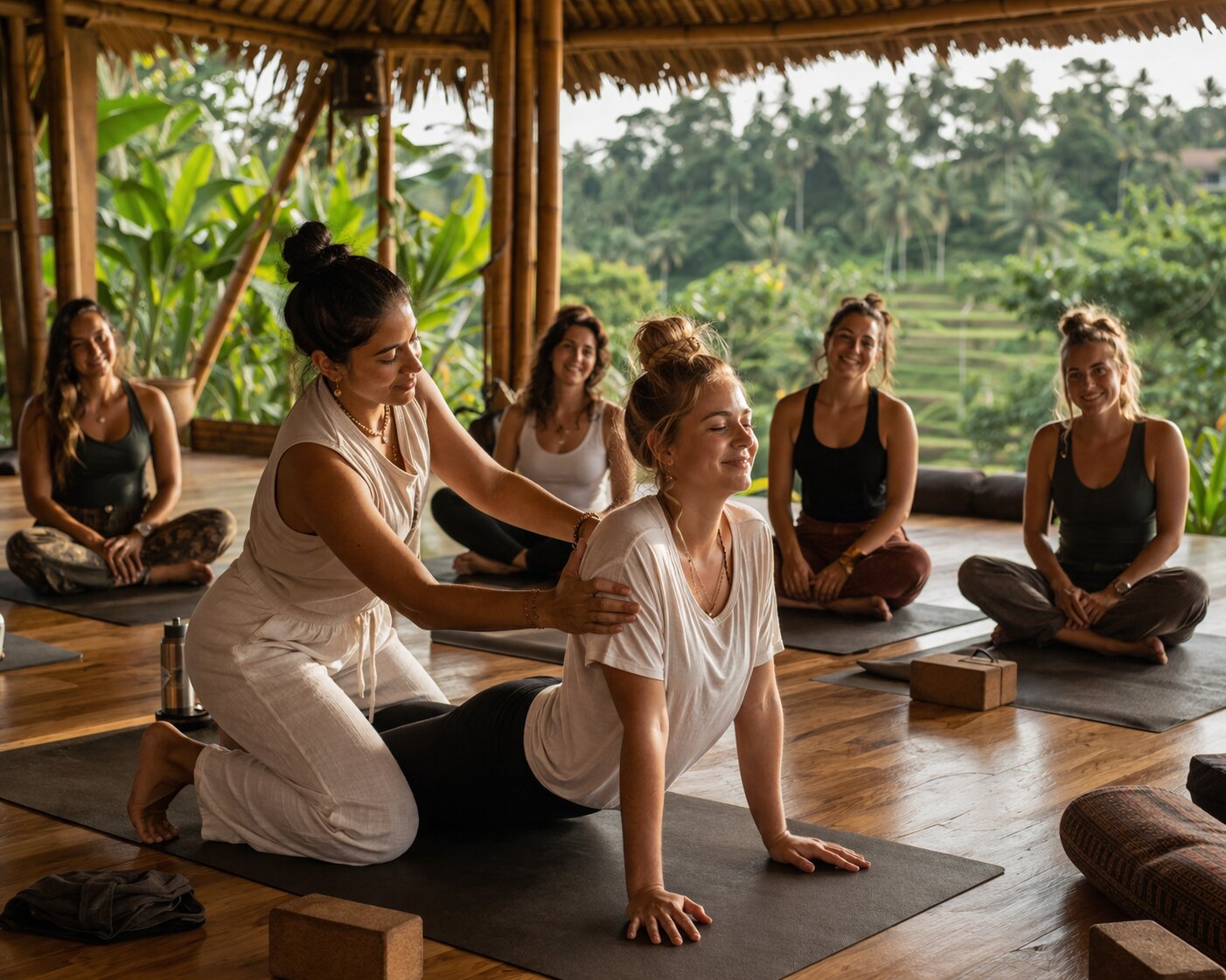
Yes, beginners can do a yoga teacher training in Bali. The 200-hour certification is a foundational program, not an advanced one. Flexibility is not a requirement. Most schools recommend 6 months of personal practice, but even that is a recommendation, not a rule. The five schools below were selected from the YTTinBali directory specifically because they’re built to support students who are starting out — small classes, strong modification teaching, and environments where asking basic questions is normal.
The question most people don’t say out loud is this: what if everyone else is better than me? You’ve been practicing for a year, maybe two. You can’t do a headstand. You’re not sure you understand what pranayama even means yet. And somewhere in the back of your head, you’ve imagined walking into a shala full of people who have been practicing for a decade and immediately looking like you don’t belong.
That image is wrong. And understanding why it’s wrong matters more than any school recommendation we could give you.
The 200-hour yoga teacher training was designed as a starting point. Not a finishing line. Most of your cohort will be in the same position you are — curious, a little nervous, and nowhere near as experienced as they imagine everyone else to be. Bali has thousands of graduates who started exactly where you are. The five schools below are ranked specifically for how well they support students from that starting point. If you want to compare beyond this filter, our guide to the 7 best yoga teacher training courses in Bali covers the highest-scoring schools across all levels, and our best affordable YTT in Bali under $2,000 covers budget options from $1,199.
Do You Need Yoga Experience to Do a YTT in Bali?
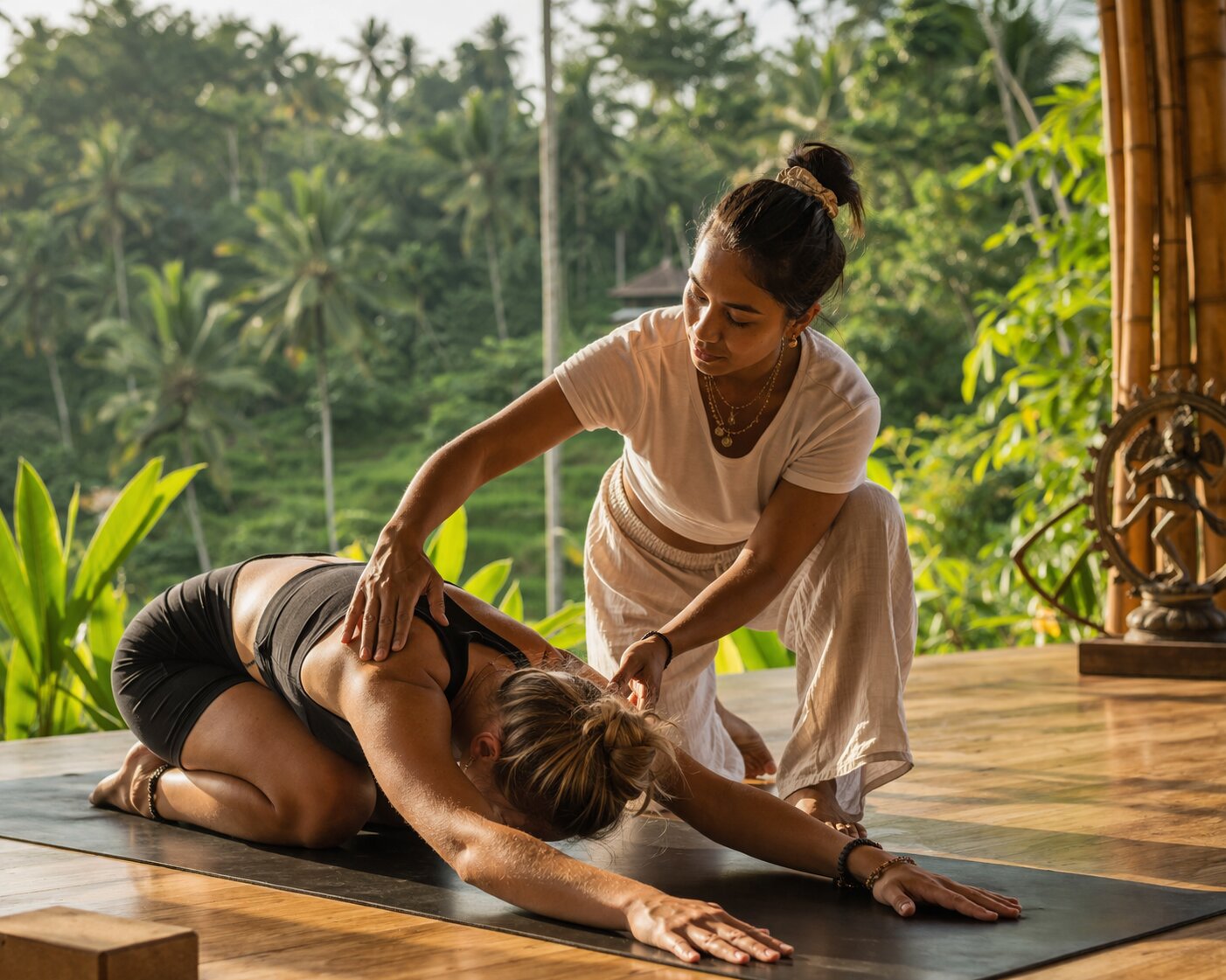
No formal experience requirement exists for a 200-hour yoga teacher training. Yoga Alliance sets the curriculum standards for registered schools but does not mandate a minimum practice history for students. The decision is made school by school.
In practice, most Bali schools recommend 6 months of regular personal practice before enrolling. That recommendation exists for a practical reason: the training schedule runs 8 to 10 hours a day across 21 to 28 days. Students with an established physical baseline adapt to that intensity faster in week one. It’s not gatekeeping. It’s just honest advice about what makes the first week less overwhelming.
What actually matters more than experience level is how you show up. Students who arrive curious, willing to be corrected, and not attached to looking polished tend to get far more from the training than people with 5 years of practice who struggle to accept beginner feedback. The skills that make a good yoga student are not the same as the skills that make a good yoga teacher, and the training is specifically designed to teach the latter from scratch.
If your practice is less than 6 months, you have two honest options. The first is a 100-hour YTT as a taster before committing to the full 200. It doesn’t give you a standalone Yoga Alliance credential, but it counts toward your 200-hour total if you return later. The second is to go straight to the 200-hour at a school that explicitly supports beginners and go in knowing the first week will be physically demanding. Many graduates describe exactly that first week as the most important part of the whole experience.
What Beginner-Friendly Actually Means
Every school in Bali claims to be “open to all levels.” That phrase is almost meaningless as a filter. Here are five things that actually tell you whether a school is built for beginners or just willing to accept them.
- Class size under 20. This is the single most important factor for beginners. In a cohort of 30 or more, you are largely invisible. Your teaching practicum gets general feedback, not specific feedback. Your alignment corrections happen when a teacher happens to notice you. In a group of 20 or fewer, teachers see what you’re doing every session. The difference in how much you improve is significant.
- Modifications are core curriculum, not an afterthought. A genuinely beginner-friendly school teaches modifications for every posture as a standard part of the asana curriculum, not as an adjustment offered quietly when someone struggles. You’re not just learning the pose. You’re learning how to teach it to every body, including bodies that look like yours right now.
- Multi-style rather than advanced single-style. Schools built primarily around advanced Ashtanga practice are excellent for experienced practitioners. For beginners, a multi-style curriculum covering Hatha, Vinyasa, and Yin provides a broader foundation and puts less pressure on physical capacity in the first week.
- Teaching practicum structured to build confidence gradually. At some schools, you’re in front of the class leading a sequence in week one. At others, the practicum builds slowly from peer practice to supervised teaching over several weeks. For beginners, the latter structure works better. Ask the school how their practicum is sequenced before you book.
- Reviews specifically mention beginner support. Search for reviews that mention starting with little experience. If a school is genuinely good for beginners, graduates will say so specifically. Phrases like “I hadn’t practiced much before” or “the teachers made everyone feel supported regardless of level” are the signal you’re looking for.
What to Expect in Your First Week
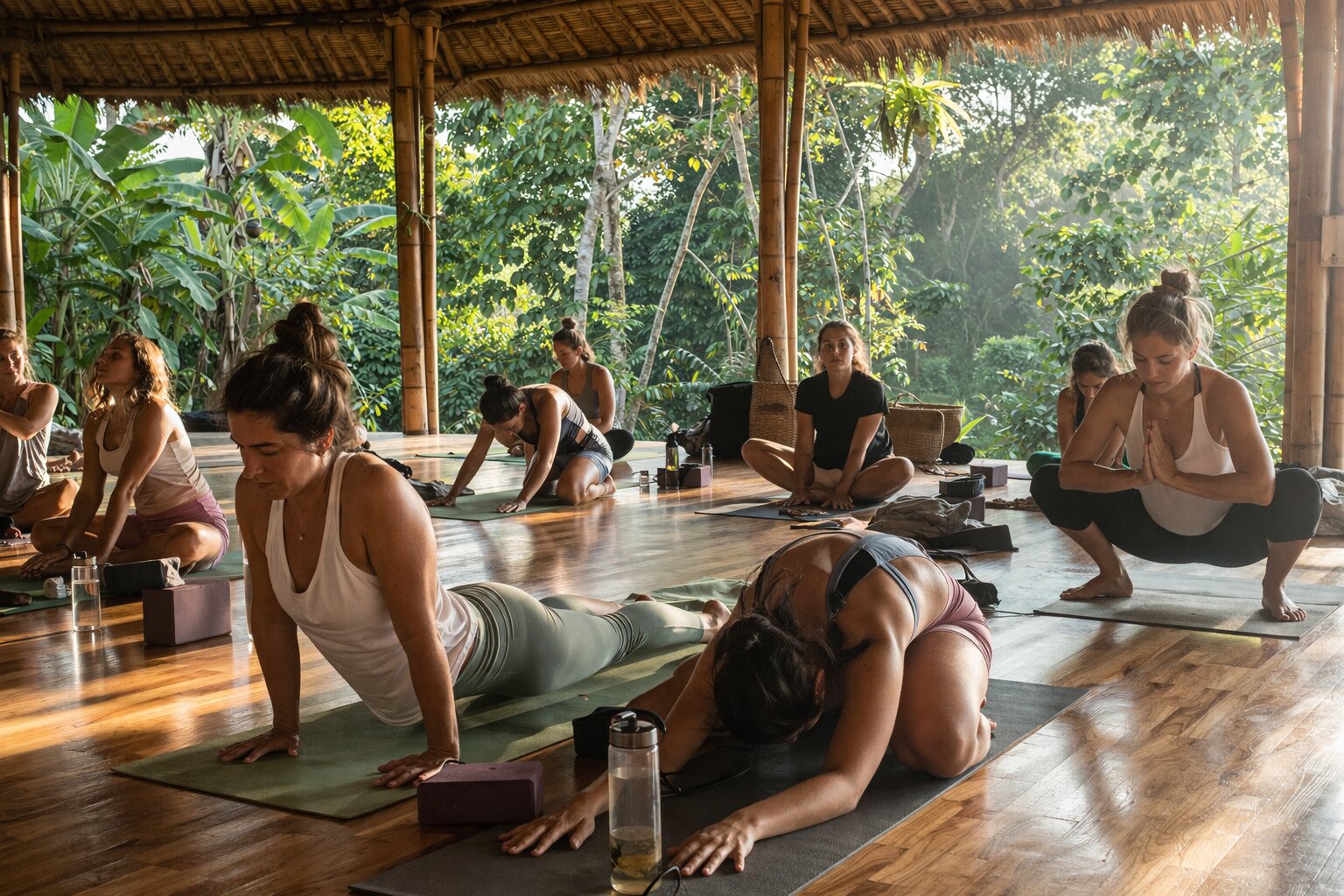
The first week is almost universally the hardest, and almost universally described by graduates as worth it. Here’s what to actually expect.
Physically, your body will be tired in ways you’re not used to. Two to three hours of asana practice a day is more than most people do in a week. Muscles you didn’t know existed will let you know they exist. This is normal. It passes. Most schools build in rest days and the schedule eases from intense to sustainable across the first few days as your body adapts.
Mentally, the volume of information is significant. Anatomy, philosophy, Sanskrit terms, sequencing principles, adjustment cues. You won’t retain all of it in week one. You’re not supposed to. The residential format helps: because you’re sleeping, eating, and practicing in the same community, information that doesn’t land in the lecture often surfaces in conversation over breakfast or during evening meditation. Learning happens across the whole day, not just in the classroom.
The imposter syndrome usually peaks around day three and then starts to ease. That’s not a coincidence. By day three, most students have realised that everyone else is as uncertain as they are, that teachers are not judging their postures but teaching them, and that the environment is genuinely supportive rather than performative. The feeling of “I shouldn’t be here” is almost always replaced by “I’m exactly where I should be” by the end of week one. It’s not guaranteed, but it’s common enough that it’s worth knowing in advance.
The Best Yoga Teacher Training in Bali for Beginners
The five schools below are the highest-scoring programs in the YTTinBali directory selected specifically for beginner suitability: small class sizes, explicit beginner welcome, strong modification teaching, and review records that confirm the experience matches the promise. Trust scores are calculated from aggregated review data across Google, Facebook, and Tripadvisor. No school pays to be here.
Use our comparison tool to place any two schools side by side before committing.
Shades of Yoga — Ubud

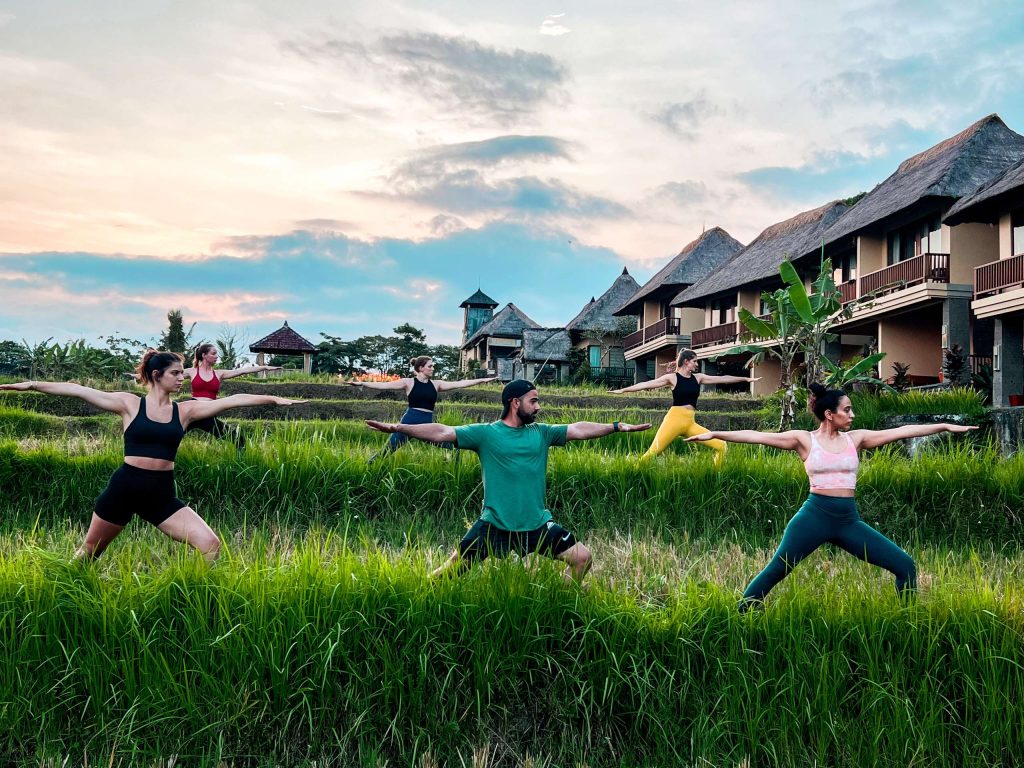
This school has earned the Namoo Choice badge based on publicly available student review data.
Verified by Students
Rating aggregated from publicly available third-party review data. Namoo does not host user reviews directly.
Upcoming Intakes
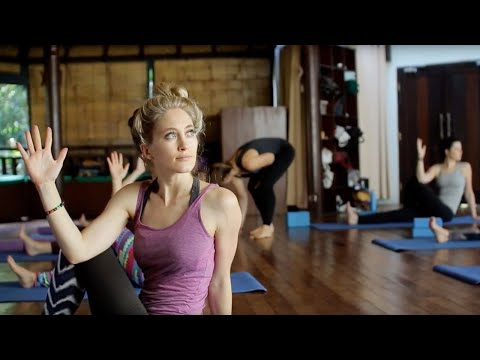
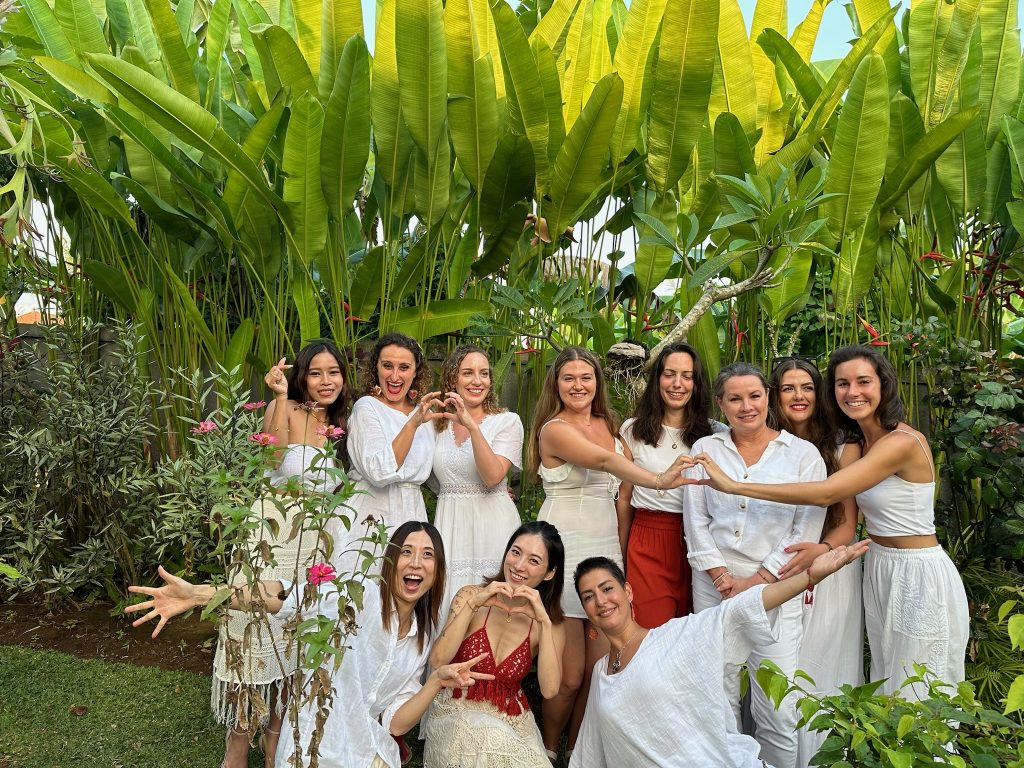
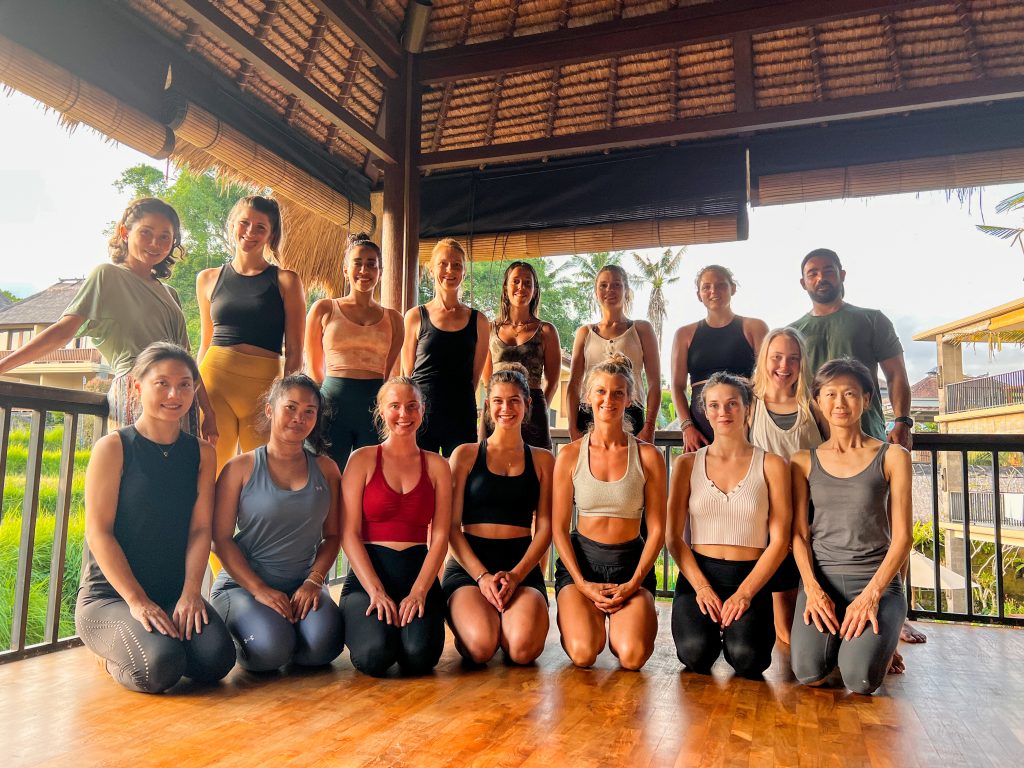
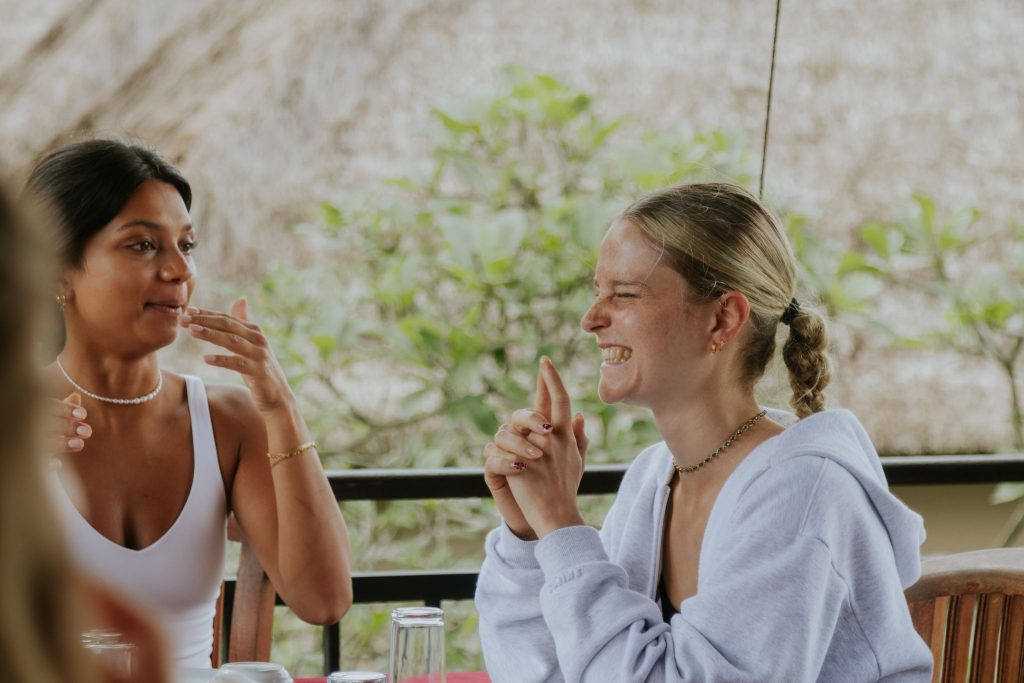
Shades of Yoga keeps its cohorts deliberately small, and that decision shapes everything about what the training feels like for a beginner. When a lead teacher is responsible for 10 students rather than 25, feedback stops being general and starts being specific to you. Your alignment, your teaching voice, your specific patterns under pressure — these get actual attention rather than group-level notes that may or may not apply to you. For students who are starting out and need real feedback to improve, the difference between a small cohort and a large one is not a detail. It’s the core of the experience.
The curriculum covers Hatha, Vinyasa, and Yin, with breathwork, meditation, and philosophy integrated throughout rather than delivered as separate modules. The grounding quality of the school, a word graduates use consistently enough across independent reviews that it’s clearly reflecting something real, comes partly from the Ubud setting and partly from the deliberate pace of the program. Days feel coherent rather than rushed. You absorb more because you’re not just racing through content.
With a trust score of 89/100 and 266 verified reviews averaging 4.9 stars, Shades of Yoga has a review record built over years of consistent delivery. If the primary thing you need from a beginner program is genuine personal attention and space to process what you’re learning, this is the school to look at first.
Power of Now Oasis — Sanur
This school has earned the Namoo Choice badge based on publicly available student review data.
Verified by Students
Rating aggregated from publicly available third-party review data. Namoo does not host user reviews directly.
Power of Now Oasis in Sanur is one of the most explicit about beginner inclusion of any school in the directory. Their published program information states the training is open to all dedicated practitioners, including beginners, and mentions specifically that some students start their yoga journey during the course itself. That’s not marketing language hedged in small print. It reflects a school that has built its teaching structure around varying levels of incoming experience rather than assuming a baseline.
The logistics support this. Maximum 20 students, three lead teachers. That ratio, one teacher for every 6 to 7 students during practice sessions, means the feedback quality is high and no student goes unnoticed. The school’s beachfront location in Sanur, a calmer and more relaxed part of Bali compared to Ubud or Canggu, adds a layer of ease to the experience. Sanur’s pace suits beginners well: there’s less social noise competing for your attention and more space to just be in the training.
The curriculum includes Hatha and Vinyasa as core practices alongside anatomy, Ayurveda, acro yoga guest workshops, and strong philosophy modules. The school is semi-non-profit, with profits supporting local community initiatives. With 704 verified reviews across Google, Facebook, and Tripadvisor averaging 4.7 stars and a trust score of 85/100, the review base here is one of the strongest in the directory for a school outside Ubud.

All Yoga Training — Ubud
This school has earned the Namoo Choice badge based on publicly available student review data.
Verified by Students
Rating aggregated from publicly available third-party review data. Namoo does not host user reviews directly.
Upcoming Intakes
All Yoga Training built its 200-hour curriculum around two parallel tracks: a Modified Primary Series specifically designed for beginners, and the traditional Ashtanga Primary Series for intermediate and advanced students. Running both within the same training means beginners are never stretched beyond their current capacity, and never held back by a curriculum designed for a level above them. That structural decision is one of the most practically honest things a school can do for mixed-level cohorts, and it’s relatively rare.
The school is based on Nusa Lembongan, a small island about 30 minutes from the Bali mainland by fast boat. The location removes a specific kind of distraction that urban Bali training can’t always avoid: there’s simply less to do between sessions, which means students tend to rest, process, and prepare rather than fill their evenings with the social activity that can quietly undermine the physical demands of an intensive program. For beginners who need to recover properly between sessions, that matters.
Running since 2009 with over 3,500 graduates, All Yoga Training has one of the longest track records of any school in the directory. Class size is capped at 22 students with personal mentoring built into the format. With 230 verified reviews, a 5.0 star average on Google, and a trust score of 84/100, the record is consistent. The program runs monthly across most of the year, so intake flexibility is strong.
House of Om — Pelaga
Verified by Students
Rating aggregated from publicly available third-party review data. Namoo does not host user reviews directly.
Upcoming Intakes
House of Om’s Pelaga location sits in Bali’s northern highlands, above the rice paddies and well away from any tourist circuit. The cool climate, forested surroundings, and almost complete removal from the rhythm of tourist Bali create something that’s genuinely useful for beginners: a training environment with no competing distractions and no social pressure to keep up with an image of what a yogi is supposed to look like. You’re just doing the work, in a place built entirely for doing the work.
The school explicitly states that no yoga experience is required. That commitment carries through to the curriculum design, which is multi-style and starts from foundational principles rather than assuming incoming fluency. Hatha, Vinyasa, and meditation form the backbone, with philosophy woven throughout. House of Om has trained tens of thousands of graduates across its multiple Bali locations, and the scale of that experience means the program has been refined through iteration in a way that benefits beginners directly: the awkward moments in week one have been anticipated and designed around.
The trust score of 84/100 is backed by 601 aggregated reviews across Google, Facebook, Tripadvisor, and the Yoga Alliance directory averaging 4.9 stars. For a beginner who wants maximum focus on the training itself and minimum friction from the environment around it, Pelaga is one of the most purposeful settings in the directory.
Yoga New Vision — Ubud
Verified by Students
Rating aggregated from publicly available third-party review data. Namoo does not host user reviews directly.
Yoga New Vision takes a different approach from most schools in Bali. The curriculum is built explicitly around bridging scientific research with traditional yogic philosophy, which means anatomy, physiology, and the biomechanics of movement get unusually detailed coverage alongside the classical philosophical framework. For beginners who have spent years doing yoga without really understanding what’s happening in their body, this kind of systematic grounding is particularly valuable. You stop mimicking shapes and start understanding why certain movements work and what happens when they don’t.
The school is based in Ubud and runs programs in Hatha and Vinyasa with a strong emphasis on intelligent alignment, sequencing, and the reasoning behind both. This is not a curriculum that rushes past the “why.” It makes the why the centre of the training. Students who tend to learn by understanding rather than repeating tend to respond well to this structure, and beginners without ingrained movement habits often absorb it faster than practitioners who have been doing things a particular way for years and have to unlearn some of it.
With a trust score of 84/100 and 502 verified reviews averaging 5.0 stars across Google, Facebook, and the Yoga Alliance directory, Yoga New Vision has a strong and credible review record for its size. Priced from $2,299, it sits at a reasonable mid-range for Ubud and offers early bird discounts of up to $300 for students who book ahead. For analytically minded beginners who want the full intellectual dimension of yoga training alongside the physical, this is the most distinctive option on this list.
Find the Right Beginner YTT in Bali for You
Every school here is Yoga Alliance-certified and has been selected for how well it supports students who are starting out. The right one depends on what kind of learner you are. If you need personal attention above everything else, Shades of Yoga’s small cohorts are the clearest answer. If you want the most explicitly beginner-supportive environment with a strong teacher-to-student ratio, Power of Now Oasis. If you process information better when it comes with a scientific framework, Yoga New Vision. If removing every possible distraction sounds like what you need, Pelaga.
Browse the full profiles of two or three schools that caught your attention, then use our comparison tool to look at them side by side. You’ll compare trust scores, class sizes, curriculum styles, accommodation, and upcoming dates in one view. The full directory has more options if none of these fit.
Frequently Asked Questions
Can a complete beginner do a 200-hour yoga teacher training in Bali?
Yes. The 200-hour program is a foundational certification, not an advanced one. No formal experience requirement exists across Yoga Alliance-registered schools. Most schools recommend 6 months of regular personal practice before enrolling, not because beginners are excluded but because the daily schedule is physically intensive and some baseline helps in week one. Students with less practice can start with a 100-hour program as a taster, or go straight to the 200-hour at a school explicitly built for mixed levels.
Do I need to be flexible to do yoga teacher training in Bali?
No. Flexibility is a byproduct of consistent yoga practice, not a prerequisite for starting it. The 200-hour curriculum teaches you how to work with every kind of body, including bodies at the beginning of their movement journey. Teachers are not evaluating how far you can stretch. They’re evaluating whether you’re learning how to cue, sequence, adjust, and teach. Those are skills that have nothing to do with how far your hamstrings go.
How physically demanding is a yoga teacher training for beginners?
The first week is the most demanding. Daily asana practice runs 2 to 3 hours, often twice a day at some schools. On top of that, there are lectures, philosophy sessions, anatomy classes, and teaching practicum. Most students feel physically tired by the end of day three. By the end of week one, the body has adapted significantly and the schedule starts to feel more manageable. Rest days are built in. The residential format also helps because you’re not commuting or cooking — your energy goes entirely into the training.
What yoga styles are best for beginners in a Bali YTT?
Multi-style programs covering Hatha, Vinyasa, and Yin are the most beginner-friendly. Hatha provides the alignment foundation, Vinyasa introduces flow and sequencing, and Yin adds the restorative and meridian-based dimension. Schools that focus primarily on advanced Ashtanga are excellent but can be physically intense in the first week for students without that specific practice background. The schools on this list all offer multi-style curriculums or have beginner-specific tracks built into their Ashtanga programs.
How do I know if a school is genuinely beginner-friendly, not just claiming to be?
Three checks: class size (look for 15 or fewer), curriculum structure (ask whether modifications are core curriculum or just offered on request), and independent reviews (search specifically for graduates who mention starting with little experience). A school with 200-plus reviews where multiple graduates mention arriving as beginners and feeling supported is giving you real signal. Our trust score methodology aggregates this review data across Google, Facebook, and Tripadvisor so you can see the overall picture without visiting 10 different platforms.